
Curriculum System Framework
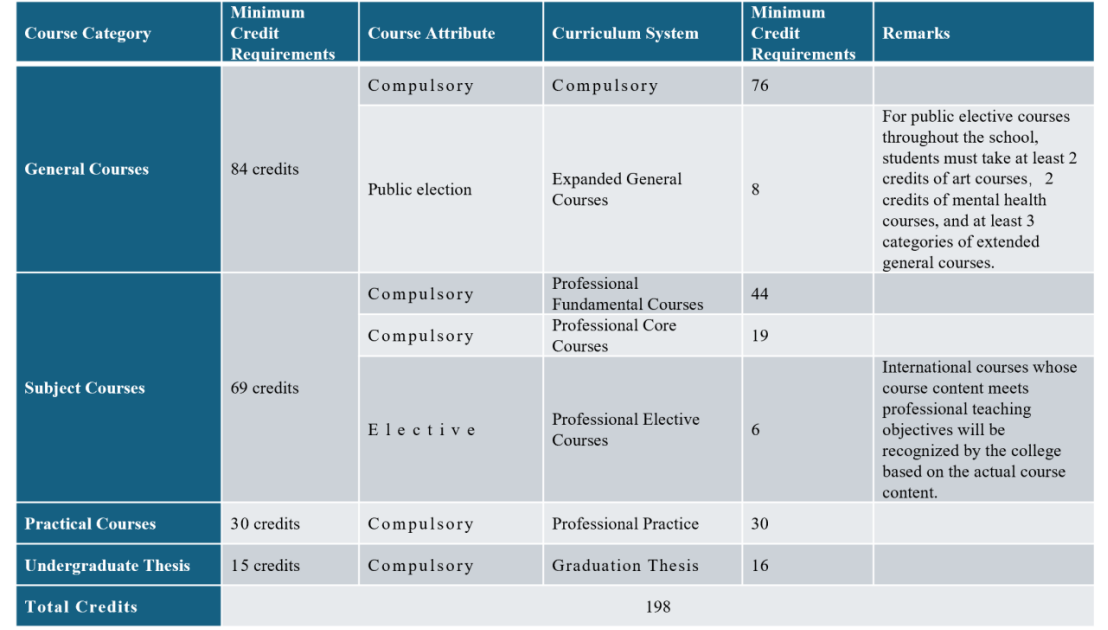
The Automation program curriculum consists of general education courses, professional subject courses, practical courses, and graduation thesis.
Course Teaching Module
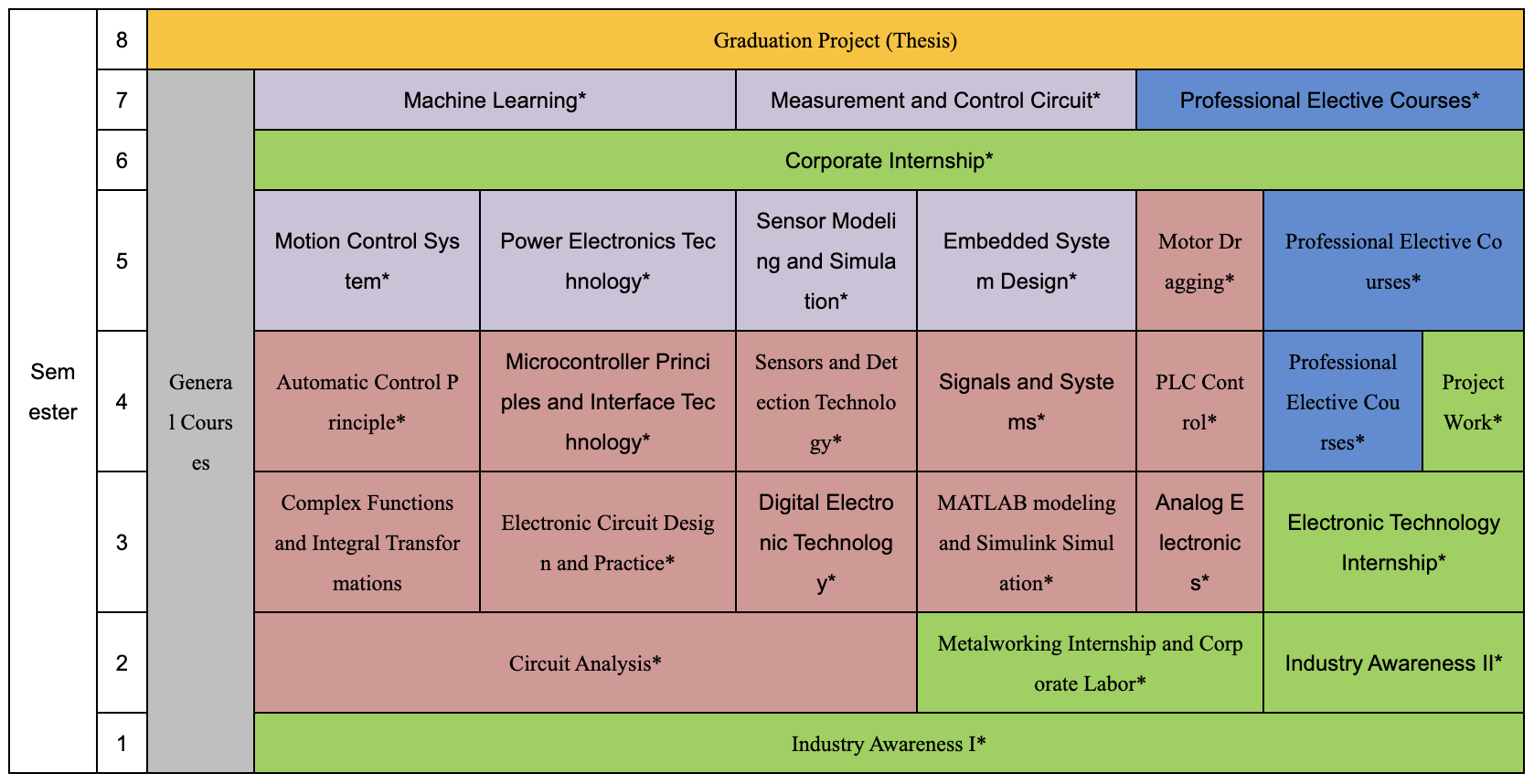
Note:
1. Courses with * include practical course modules.
2. The gray indicates general courses; the pink indicates professional basic courses; the purple indicates professional core courses; the blue indicates professional elective courses; the green indicates is professional practical courses; the yellow indicates graduation thesis.
Core Knowledge Areas
The core knowledge areas of this major include: modeling and simulation, sensing and measurement, drive and servo, control and intelligence.
Core Professional Courses
The core curriculum of the discipline is centered around the fundamental knowledge of industrial automation, power electronics technology, detection technology, and intelligent instruments and meters. It includes both basic professional courses and core professional courses.
Basic courses
Engineering drawing, fundamentals of control engineering, mechanical principles, mechanical design, theoretical mechanics, material mechanics, electrical engineering, engineering materials, interchangeability and measurement technology, etc.
The foundational courses for the major include: Circuit Analysis, Analog Electronics, Digital Electronics, Functions of a Complex Variable and Integral Transforms, Signals and Systems, Microcontroller Principles and Interface Technology, Sensors and Detection Technology, Principles of Automatic Control, Electric Drive, PLC Control, MATLAB Modeling and Simulink Simulation, etc.
Professional Courses:
The core courses of the major include: Motion Control Systems, Power Electronics Technology, Sensor Modeling and Simulation, Embedded System Design, Machine Learning, and Measurement and Control Circuits.
Robotics and Intelligent Manufacturing Direction: Industrial Robot Technology, Fundamentals of Mechanical Manufacturing Technology, Digital Intelligent Production Line Design, etc;
Advanced electromechanical equipment design direction: electromechanical transmission control, electromechanical equipment design, intelligent equipment fault diagnosis and maintenance, basic principles and applications of PLC.
Practical Education Process
We have established cooperative relationships with nearly 30 enterprises; Co construction of school enterprise cooperation practice base and co creation of school enterprise joint laboratory group; Organize and guide students to participate in "industry academia research" practice; Cultivate excellent engineers who understand the industry, know technology, and are capable of research and development.
According to the training program for the automation major, there are currently 21 courses that offer experimental classes, 20 of which include comprehensive and design-oriented experiments. These comprehensive and design-oriented experiments account for 95.2% of all experiments. The major currently has 10 specialized laboratories, all of which are open labs, with opening hours from Monday to Sunday, 8:30 am to 10:00 pm, meeting the experimental needs of over 95% of the students in this major.
Approval has been granted for the establishment of the Guangdong Provincial Experimental Teaching Demonstration Center-Digital Manufacturing Training Center, which is operating well. Partnerships have been established with leading enterprises such as Würth (Shenzhen), Han's Laser, BYD, JPT, Tanaka Precision Machinery, and Yifeng Automation to set up 62 off-campus internship cooperative enterprises. In addition, there are 2 joint laboratories and 1 elite class for talent cultivation, with the number and capacity of off-campus internship and training bases meeting the requirements for educational operations.
By the end of 2023, an application-oriented talent training model emphasizing practical teaching and collaboration between schools and enterprises had been established. Students in this major have won over 50 national-level awards in various disciplinary competitions within the field and more than 70 awards of other types, continuously enhancing the ability to serve society and the professional influence.
The college selects outstanding students to participate in short-term exchange and learning activities overseas every semester. Senior students also have the opportunity to go to countries such as Germany and Switzerland for long-term exchange and learning.
Telephone:+86 755-23256198
Zip code:518118
Address:No. 3002, Lantian Road, Pingshan District, Shenzhen, Guangdong, China.

SZTU WeChat Public Account

SGIM WeChat Public Account

Copyright @SZTU
