
Overall framework of curriculum system
The program consists of 180 credits, including 64 credits of general education courses, 68 credits of discipline-specific courses, 33 practicum courses, and 15 credits of thesis.
Course Type |
Minimum Credit Requirements |
Course Attributes |
Course System |
Minimum Credit Requirement |
Remarks |
General Studies Program |
64 credits |
Compulsory |
Basic Liberal Studies |
58 |
|
Publicly Selected |
Extended Liberal Studies |
6 |
University-wide public elective with a minimum of 2 credits of art courses and a minimum of 3 categories of Extended Liberal Arts courses. |
||
Academic Programs |
68 credits |
Compulsory |
Specialized Basic Courses |
43 |
|
Compulsory |
Specialized Core Courses |
16 |
|||
Electives |
Specialized Elective Courses |
9 |
International courses whose contents are in line with the teaching objectives of the major shall be recognized by the faculty according to the actual contents of the courses. |
||
Practical Courses |
33 credits |
Compulsory |
Professional Practice |
33 |
|
Undergraduate Dissertation |
15 credits |
Compulsory |
Thesis |
15 |
|
Total Credits |
180 |
||||
Course teaching module
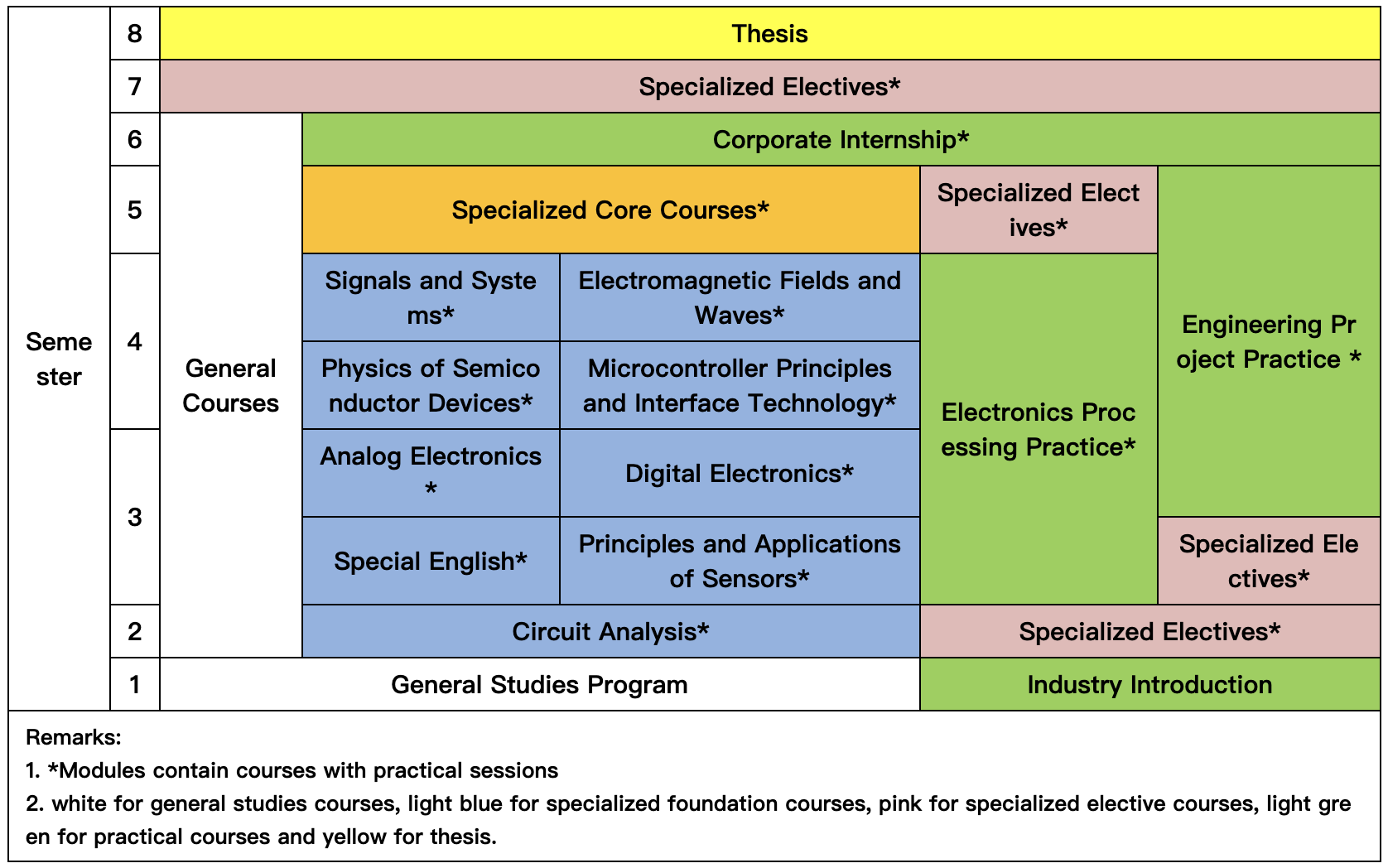
Core professional courses
(I) Specialized Fundamentals
Circuit Analysis, Linear Algebra, Probability Theory and Mathematical Statistics, Analog Electronics, Digital Electronics, Semiconductor Device Physics, Signals and Systems, Sensor Principles and Applications, Microcontroller Principles and Interfacing Technology, Advanced Language Programming, Physical Optics, Electromagnetic Fields and Electromagnetic Waves, and so on.
(II) Specialized Courses
1. Optoelectronic Devices and Integration: Applied Optics, Fundamentals of Laser Principles, Digital Image Processing, Optoelectronic Detection Technology, Laser Devices and Systems, and so on.
2. Intelligent Circuits and Systems: Embedded System Design, Computer Networks, FPGA and Hardware Description Languages, RF Electronic Circuits, Automatic Control Principles and Techniques, and so on.
Practical teaching process
The program focuses on cultivating students' practical ability. In addition to the practice within the theoretical courses, there are 40 courses with pure practical credits, including industry awareness, electronic process internship, engineering project practice, metalwork internship, enterprise internship and production work and graduation internship, and so on.

Telephone:+86 755-23256198
Zip code:518118
Address:No. 3002, Lantian Road, Pingshan District, Shenzhen, Guangdong, China.

SZTU WeChat Public Account
SGIM WeChat Public Account

Copyright @SZTU
