
Overall framework of curriculum system
The courses of Robotics Engineering include general education courses, professional subject courses, practical courses, and graduation thesis.
Course Category |
Minimum credit required |
Course Type |
Remark |
general education courses |
76 |
compulsory |
Basic general education courses |
8 |
optional |
Extended general education courses,a public elective course for the entire university, with a minimum of 2 credits of art courses and 4 credits of language courses. |
|
professional subject courses |
35 |
compulsory |
Basic professional courses |
16 |
compulsory |
Core professional courses, with the possibility of choosing the compulsory courses of the major of the other direction, provided that it is ensured that credits can be obtained for the compulsory courses of the major of the corresponding direction. |
|
8 |
optional |
Optional professional courses, of which: Extracurricular research is credited for a maximum of 5 credits. |
|
practical courses |
34 |
compulsory |
practical courses |
graduation thesis |
15 |
compulsory |
graduation thesis |
Course teaching module
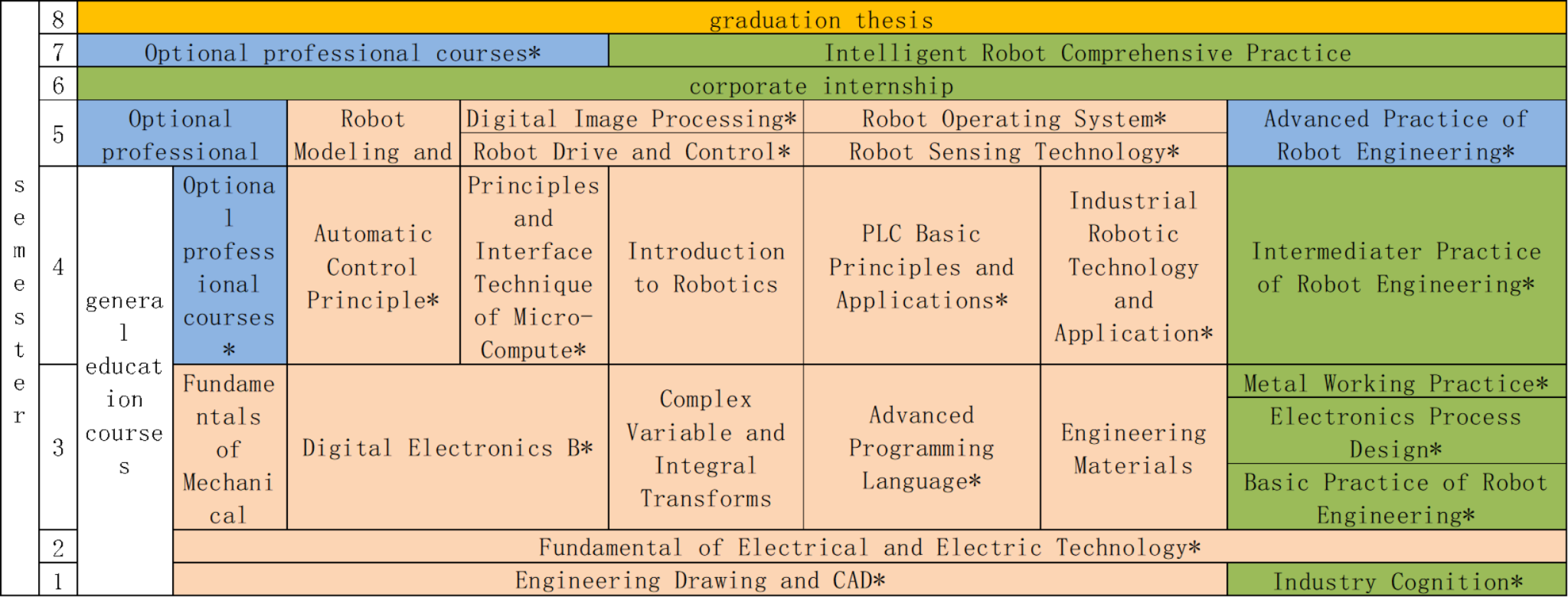
Core knowledge areas
Robotics, Robot Control Technology, Robot Intelligent Sensing Technology
professional courses
(1) Basic professional courses
Engineering Drawing and CAD, Engineering Mechanics, Fundamentals of Mechanical Design, Functions of Complex Variables and Integral Transforms, Fundamentals of Electrical and Electronic Technology, High-Level Language Programming, Principles of Microcontrollers and Interfacing Technology, Basic Principles and Applications of PLC, Principles of Automatic Control, etc.
(2) Core Professional courses:
Introduction to Robotics, Robot Drive and Control, Robot Sensing Technology, Robot Operating System, Digital Image Processing, Robot Modeling and Simulation, Industrial Robot Technology and Applications.
Practical teaching process
Participating in competitions such as RoboCup, Robocon, RAICOM, and others plays a crucial role in cultivating undergraduate students' talents in various aspects. These competitions provide students with practical opportunities to apply theoretical knowledge learned in the classroom to real-world situations. By working on robotics projects for these competitions, students can enhance their problem-solving skills, teamwork abilities, and technical expertise.
Moreover, participating in these competitions allows students to gain hands-on experience in designing, building, and programming robots, which are essential skills in today's technology-driven world. Additionally, engaging in these competitions helps students develop critical thinking, creativity, and innovation, preparing them for future challenges in the field of robotics and artificial intelligence.
Overall, through participation in RoboCup, Robocon, RAICOM, and similar competitions, undergraduate students can acquire a well-rounded and practical education that will benefit them in their future careers in the rapidly evolving field of robotics and AI.
Telephone:+86 755-23256198
Zip code:518118
Address:No. 3002, Lantian Road, Pingshan District, Shenzhen, Guangdong, China.

SZTU WeChat Public Account

SGIM WeChat Public Account

Copyright @SZTU
