
Overall framework of curriculum system
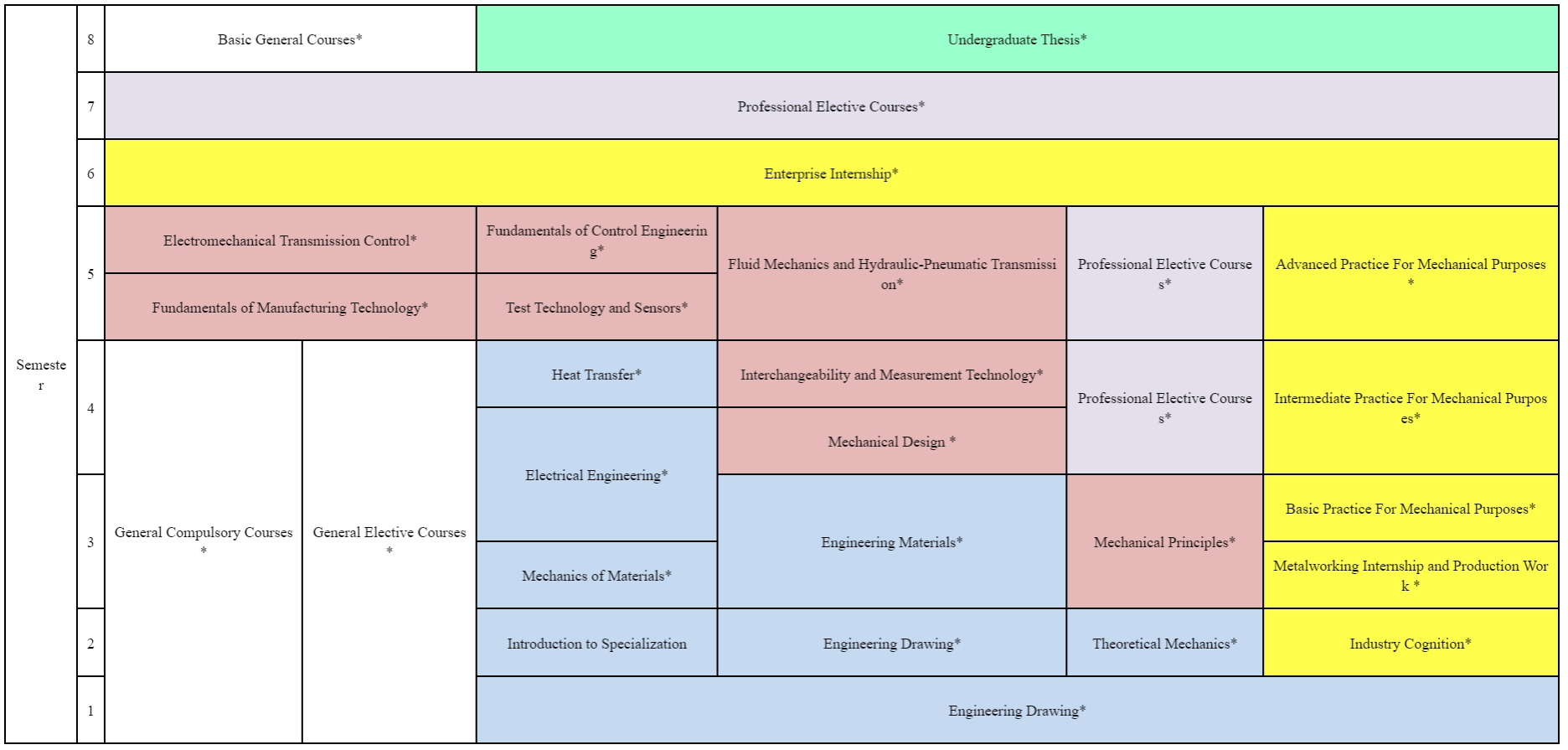
The courses of Mechanical Design, Manufacturing and Automation include general education courses, professional subject courses, practical courses, and graduation thesis.
Curriculum category |
Minimum Credit Requirements |
Course Properities |
Minimum Credit Requirements |
Notes |
General Courses |
80 credits |
General Compulsory Courses |
72 credits |
Course details are not fully displayed in Table 1 |
General Elective Courses |
8 credits |
The Extended General Education course is a public elective course for the entire school, with a total of 8 credits completed. At least 2 credits of art courses and 2 credits of mental health courses should be completed, while at least 3 types of Extended General Education courses should be taken. |
||
Professional Courses |
66 credits |
Professional Basic Compulsory Courses |
28 credits |
|
Professional Key Compulsory Courses |
28 credits |
|||
Professional Elective Courses |
10 credits |
|||
Practice Courses |
31 credits |
Compulsory Courses |
31 credits |
|
Undergraduate Thesis |
15 credits |
Compulsory Courses |
15 credits |
|
Total Credits |
192 credits |
|||
Core professional courses
(I) Specialized Fundamentals
Core knowledge areas
Mechanical principles and design methods, mechanical manufacturing processes and technologies, mechanical system transmission and control, intelligent control technology, industrial robot technology.
Core professional courses
Mechanical Principles, Mechanical Design, Fundamentals of Manufacturing Technology, Electromechanical Drive Control, Interchangeability and Measurement Technology, Fundamentals of Control Engineering, Testing Technology and Sensors, Fluid Mechanics and Hydraulic Pneumatic Transmission.
Practical teaching process
We have established cooperative relationships with nearly 30 enterprises; Co-construction of school enterprise cooperation practice base and co creation of school enterprise joint laboratory group; Organize and guide students to participate in "industry academia research" practice; Cultivate excellent engineers who understand the industry, know technology, and are capable of research and development.
lSIEMENS Siemens (China) Co., Ltd
>Jointly building an intelligent manufacturing internship and training base
>Jointly building a new intelligent manufacturing engineer school enterprise alliance
>Co construction of majors, courses, and teacher training
>Carry out scientific research technology and international exchange and cooperation
>Carry out cooperation in engineering capability qualification certification
>Carry out student innovative competition cooperation
lHan's Laser Technology Industry Group Co., Ltd
>Establish a "Laser Intelligent Manufacturing Joint Laboratory"
>Establishing the "Ethnic Intelligent Manufacturing Class"
>Co construction of practical training base
>Carry out professional course construction cooperation
>Carry out cooperation in teacher training
>Carry out scientific and technological cooperation
lWurth Group of Germany
>Provide corresponding internship opportunities and positions
>Establishing a "Joint Electromagnetics Laboratory"
>Deepen cooperation in scientific research projects
>Established school enterprise joint laboratory
>Main cooperating enterprises

The college selects outstanding students to participate in short-term exchange and learning activities overseas every semester. Senior students also have the opportunity to go to countries such as Germany and Switzerland for long-term exchange and learning.
Telephone:+86 755-23256198
Zip code:518118
Address:No. 3002, Lantian Road, Pingshan District, Shenzhen, Guangdong, China.

SZTU WeChat Public Account

SGIM WeChat Public Account

Copyright @SZTU
