
The Center for Micro-Nano Chip Industrialization (MNCI) is oriented to the frontiers of its disciplines, and is guided by the strategic needs of national major projects and the needs of regional economic development, combining modern physical principles and advanced engineering technologies, optimizing cross-disciplines, and constructing a base for the training of innovative and composite talents, so as to create internationally advanced and even leading innovative technologies, serve the Guangdong-Hong Kong-Macao Greater Bay Area, and promote the upgrading of national industries. The Center for Micro-Nano Chip Industrialization is equipped with MEMS Chip and Device Laboratory, Optoelectronics Chip and Device Laboratory, Chip and Device Packaging Laboratory, and Analog Simulation Laboratory, etc. It has a high-level teaching and scientific research team with disciplinary backgrounds covering the fields of MEMS, Optoelectronics, Optical Engineering, Lasers, Applied Physics, Materials Physics, and Computational Science.
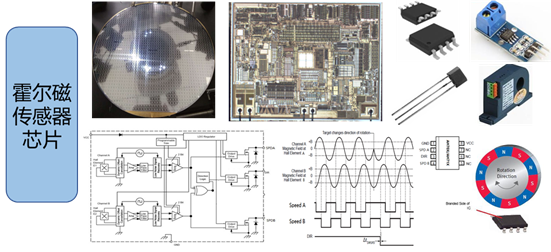
Hall magnetic sensor is a kind of magnetic field sensor made according to the Hall effect, which realizes the detection of physical quantities such as linear displacement, angular displacement, speed and direction, pressure, torque, and position by detecting the change of the applied environmental magnetic field. Integrated Hall sensors, the use of silicon integrated circuit process to integrate Hall components and measurement circuits together, realizing the material, components, circuit trinity. Hall sensors are mainly divided into two categories: switching Hall sensors and linear Hall sensors, which are widely used in industry, consumer electronics, home appliances, as well as automotive, heavy machinery and other fields.
Ion trap quantum bit chip: Any system with two possible quantum states, such as the ground state and excited state of a captive ion, can constitute a quantum bit. Ion well quantum bit, the technical principle is to use the interaction force between electric charge and electromagnetic field to hold the charged ions motion, and use the two energy levels composed of the ground state and excited state of the imprisoned ions as quantum bits, and utilize the laser-driven coupling of the quantum bits with the joint vibrational modes of the ion chain to realize the entanglement between the bits. By imprisoning multiple ions in a single potential well, the number of quantum bits can be extended to tens to hundreds. Ion well quantum bits have the longest quantum bit coherence time, and are capable of performing high-fidelity quantum state measurements and quantum gate operations, enabling the realization of programmable quantum computers based on them.

Telephone:+86 755-23256198
Zip code:518118
Address:No. 3002, Lantian Road, Pingshan District, Shenzhen, Guangdong, China.

SZTU WeChat Public Account

SGIM WeChat Public Account

Copyright @SZTU
