
Electrocardiogram and electromyography are caused by changes in electrical signals during muscle activity. They are important parameters commonly used in medical care management and are used to monitor human body fatigue status and muscle activity information. Stroke rehabilitation training centers usually provide physiological activity rehabilitation treatment for hemiplegic patients under the guidance of treating physicians, but limited medical resources cannot meet the needs of every hemiplegic patient. However, the effect of existing robot-assisted rehabilitation equipment is evaluated through traditional pre-clinical trial and post-trial results, lacking continuous testing. The physiological monitoring system developed in this project is simple and easy to operate, can record the rehabilitation training process in detail in real time, and visualize physiological information, allowing patients to optimize treatment plans during the rehabilitation process according to their own conditions and training goals, improve rehabilitation effects, and alleviate rehabilitation medical resources. Stress problems have great application prospects in auxiliary treatment of rehabilitation training.
In the rehabilitation training of hemiplegic patients, secondary injuries are more common due to reasons such as uncontrollable physical strength and excessive activity. Long-term training will cause fatigue and reduce the training effect. In view of the problems in rehabilitation training, a rehabilitation wearable physiological monitoring system based on ECG and EMG sensing was studied. The composition and testing of the system are shown in Figure 4.2.
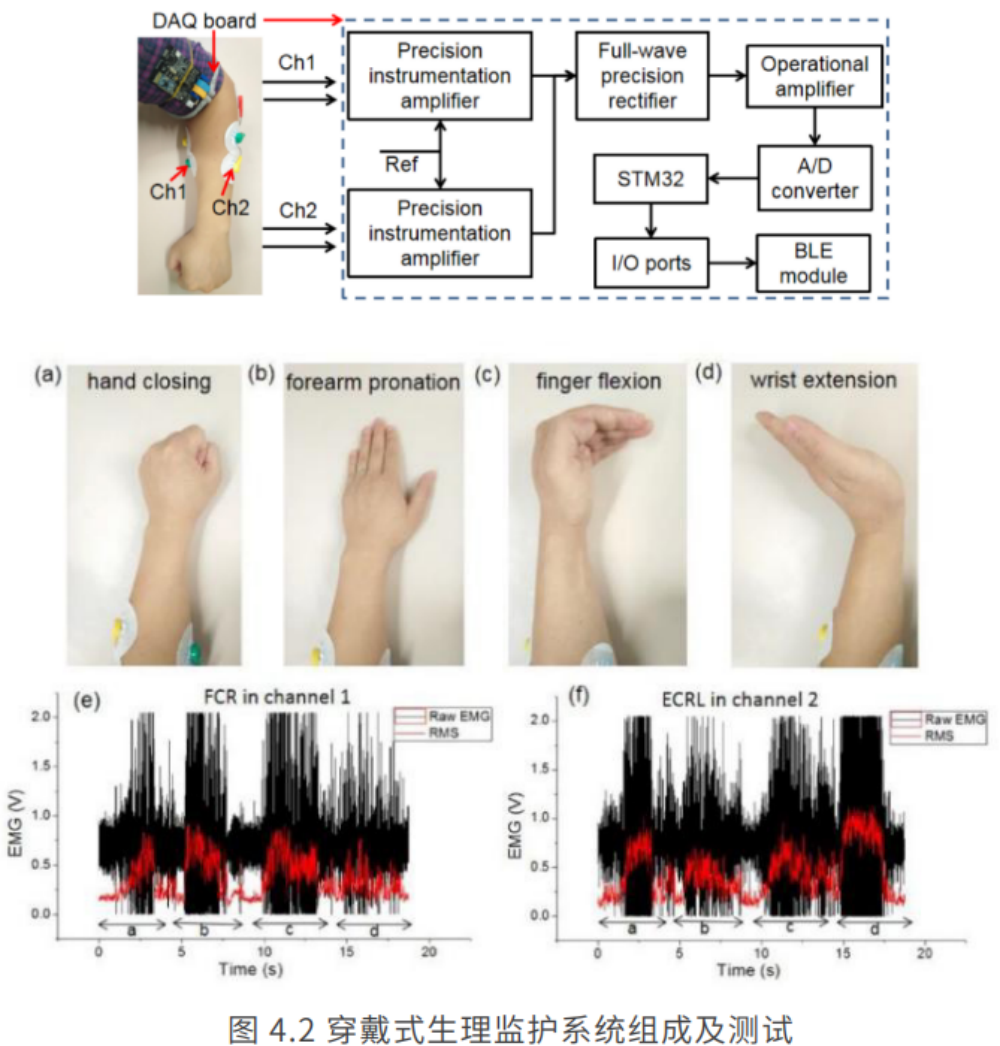
This study combines ECG and EMG sensors and uses data acquisition cards to obtain accurate signals during the training process. The collected ECG/EMG signals are filtered, amplified, digitized, and then transmitted to remote receivers through Bluetooth low energy modules. The device realizes high-precision detection of human body's ECG and EMG signals, provides a new technology for comprehensive and real-time monitoring of individual physiological information, and provides technical reference for individual customized rehabilitation programs. At the same time, based on the combination of collected signals and AI, sample data is used for machine learning training and a model is established to determine whether the body posture during the rehabilitation training process is in place and to achieve early warning and prediction. Published SCI papers; applied for multiple domestic and foreign patents; participated in the 2020 Hi-Tech Fair and applied for 1 APP software.
Telephone:+86 755-23256198
Zip code:518118
Address:No. 3002, Lantian Road, Pingshan District, Shenzhen, Guangdong, China.
SZTU WeChat Public Account
SGIM WeChat Public Account

Copyright @SZTU
