
Through Glass Via (TGV) technology, which uses quartz glass instead of silicon material, can make up for the shortcomings of TSV and is an ideal three-dimensional integration solution. In recent years, in order to promote the application of TGV technology in chips and other fields. Schott of Germany and LPKF of the United States have successively reported the preparation technology of large-area glass microhole arrays. As shown in the figure, on quartz glass with a thickness of 0.5mm, the diameter of the micropores can range from 30μm to several millimeters. This technology can not only process circular straight holes, but can also prepare round funnel holes and square holes. In addition, LPKF claims that the processing efficiency of micro holes can reach 3000-5000 per second, which can fully meet the needs of industrial mass production.
1) Preliminary research basis and results
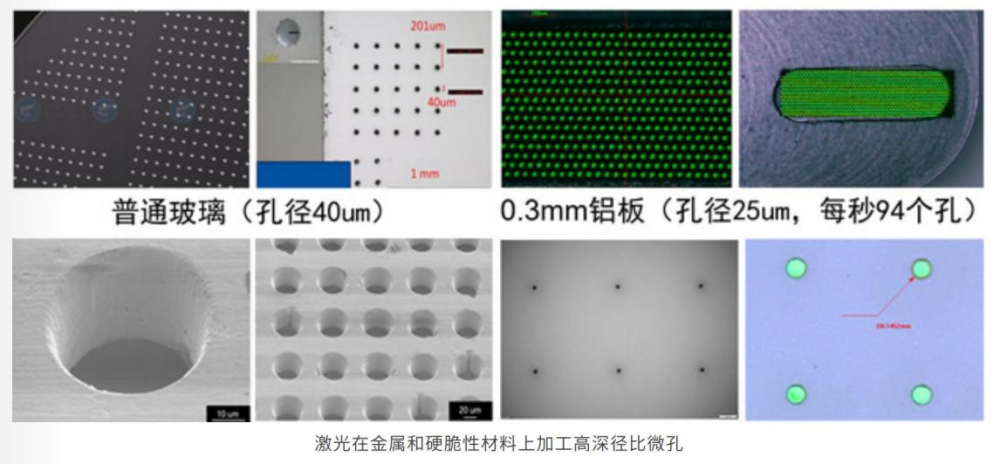
In preliminary research, nanosecond and ultrafast lasers were used to prepare high-quality micron-level through holes in various metals and hard and brittle materials, and the processing efficiency met industrial needs. In addition, in terms of preparing micropores in hard and brittle materials, invention and new utility patents have also been applied for and approved (Yang Huan; Qin Guoshuang; Zhang Jie. Laser processing system and method for drilling hard and brittle materials [P]. Invention patent. CN105598593.B, Yang Huan; Qin Guoshuang; Zhang Jie. Laser processing system for drilling hard and brittle materials [P]. Utility model. ZL20162015178.2).
2) Research plan and expected results
From January 2022 to June 2022, establish a mathematical model for the transmission and focusing of ultrafast lasers with different wavelengths and pulse widths in quartz; obtain the light field intensity distribution of the focused laser in quartz. Analyze the dynamic temperature and stress distribution in quartz glass, and based on mathematical simulation calculation results, clarify the ultrafast laser processing mechanism under the synergy of multiple parameters, and formulate the plan, experimental device and process parameters for the interaction between ultrafast laser and quartz glass. Published 1 high-level paper.
From July 2022 to December 2022, experiments will be conducted to study the focusing characteristics of light beams inside quartz glass under different systems, as well as the consistency and stability of the split beam. Study the effects of beam characteristics and processing parameters such as ultrafast laser wavelength, pulse width, pulse energy, frequency and pulse train mode on the size, shape, micro-area composition and processing efficiency of micron-scale through holes prepared on quartz glass under air and vacuum conditions. The law of influence and the law of interaction between laser and matter. Applied for 1 patent and published 1 high-level paper.
From January 2023 to December 2023, study the impact of auxiliary liquid type and concentration on laser damage threshold, material removal efficiency and quality during inverted processing, and explore debris elimination when light, quartz glass, and liquid coexist mechanism, as well as the evolution mechanism of bubbles; study the influence of the composition and concentration of the corrosion solution, corrosion temperature, and the structure and composition characteristics of ultrafast laser-modified quartz glass on the corrosion rate and micropore quality, so as to achieve high micron-level through holes. Controlled preparation with precision, quality and efficiency. Based on the technology of ultra-fast laser processing of high aspect ratio round holes, we will initially explore the laser processing technology of ultra-fast laser processing of square holes, triangular holes and other special-shaped holes on quartz glass, and summarize and compile optimized process flow and industrial application technology solutions. . Published 1 international high-level paper.
Telephone:+86 755-23256198
Zip code:518118
Address:No. 3002, Lantian Road, Pingshan District, Shenzhen, Guangdong, China.

SZTU WeChat Public Account

SGIM WeChat Public Account

Copyright @SZTU
