
Using trace amounts of samples to obtain ultra-high-precision detection is currently a hot topic in the field of surface-enhanced Raman spectroscopy (SERS), especially how to position and concentrate the droplets to be measured and quickly capture tiny concentration areas on a micro-Raman spectrometer. It is crucial for automated measurement and the promotion of this technology. This project aims at the broad engineering application prospects of femtosecond laser processing technology in the preparation of SERS substrates, and carries out the systematic preparation of patterned superhydrophobic SERS with differences in adhesion by femtosecond laser for typical SERS substrate materials such as silicon, metal and glass. Research to achieve high-precision Raman spectroscopy detection of low-concentration trace samples and rapid capture of droplet concentration areas under a micro-Raman spectrometer, and further clarify the process mechanism and control mechanism of laser-prepared patterned hierarchical micro-nanostructures, and The SERS enhancement mechanism on structured surfaces will lay a solid foundation for the further engineering and practical application of laser-prepared SERS substrate technology.
1) Preliminary research basis and results
A 515 nm@10ps ultrafast laser was used to etch a cross groove pattern on the surface of pure titanium to construct a typical micro-nano hierarchical structure (MNHS). The contact angle was obtained after modification with a low surface energy reagent. The low adhesion superhydrophobic surface with a rolling angle of 162.3° and a rolling angle of 2° and a patterned superhydrophilic pattern enable the control of the shape and size of the nanoparticle deposition pattern. The results were published in Optics Letters, 2017, Vol.42.
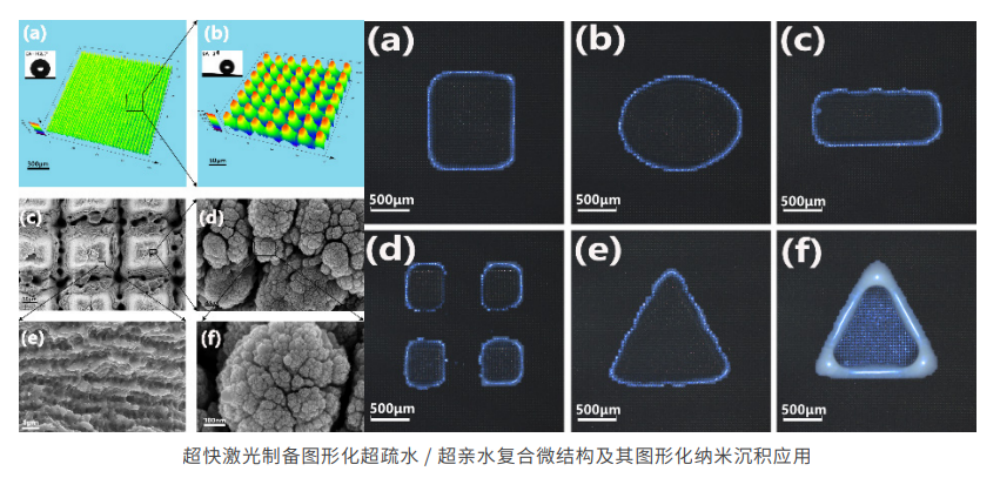
2) Research plan and expected results
From January 2022 to June 2022, the finite difference time domain method (FDTD) was used to establish a corresponding structure type based on the typical micro-nano hierarchical structure prepared by femtosecond laser, combined with the hydrophobic silver film covered on its surface. The three-dimensional model was used to numerically simulate the surface electric field distribution of the micro-nano structure under the irradiation of external laser under the excitation of incident light of 325 nm, 457 nm and 532 nm respectively. Use the constructed mathematical model to study the emission light transmission mechanism and light field distribution under the micro-nano composite structure, analyze the impact of micro-nano pattern structural characteristics and shape size on light extraction efficiency, and explore the impact of excitation light wavelength on SERS activity. Published 1 high-level paper.
From July 2022 to December 2021, design the testing and comprehensive evaluation methods for the hydrophobicity, stability, and durability of superhydrophobic structures on the surfaces of typical SERS base materials (silicon, metal, glass, etc.), and study femtosecond laser engraving The influence mechanism of the typical superhydrophobic surface rough structure size and structure type prepared by etching on its hydrophobic properties, and the relationship and control between the rolling properties, microstructure type and rough interface micromorphology of the superhydrophobic surface and the water droplet rolling angle and contact angle. Study the mechanism. Through comparative analysis of experimental results, we can understand the influence of the size and shape of the central high-adhesion pattern on the patterned superhydrophobic surface prepared by femtosecond laser and the size and type of surface micro-nano structures on SERS performance. 1 horizontal paper and complete project completion report
Telephone:+86 755-23256198
Zip code:518118
Address:No. 3002, Lantian Road, Pingshan District, Shenzhen, Guangdong, China.

SZTU WeChat Public Account

SGIM WeChat Public Account

Copyright @SZTU
