
(1) High-power picosecond lasers have important applications in scientific research and industrial production, especially in the field of processing brittle materials. UV picosecond lasers have unique advantages. High-power coherent mid-infrared laser (2-20 μm) light source has the characteristics of wide spectral range and good coherence. In particular, this band covers the fingerprint area of many biomolecules, which is very important in molecular spectroscopy of the electromagnetic spectrum and in industry. It is widely used in manufacturing, precision measurement, scientific research, military and national defense and other fields, and is highly valued by various countries.
1) Preliminary research basis and results
a) UV 355nm picosecond laser
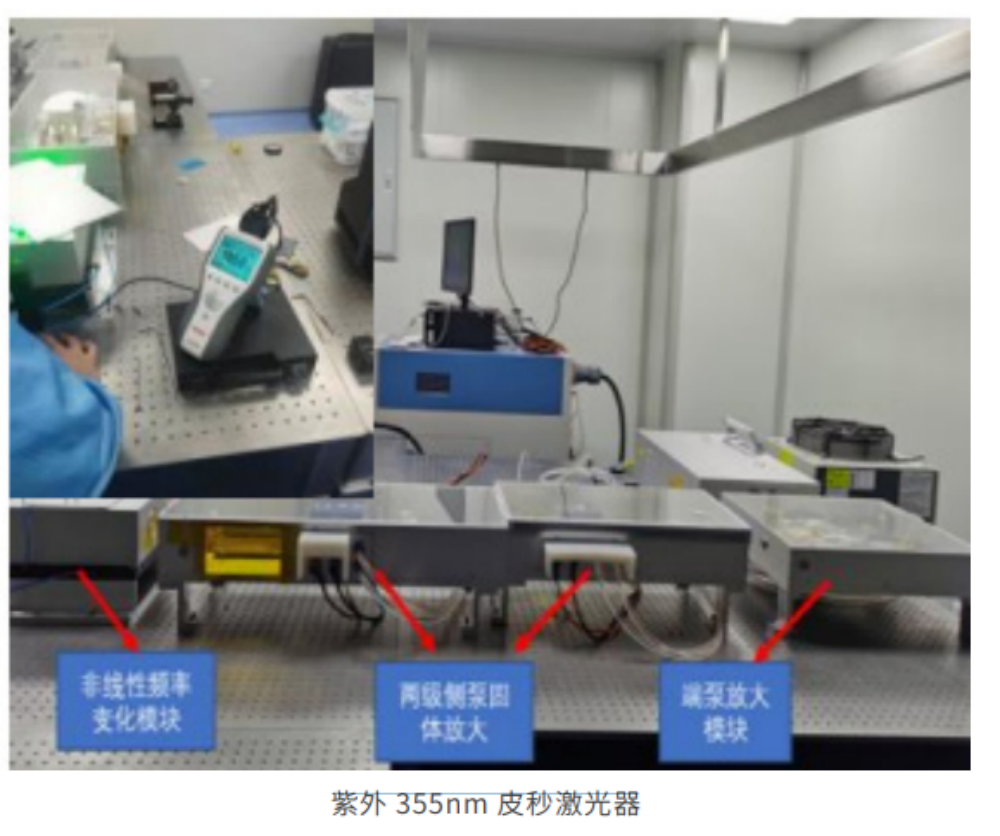
High-power picosecond lasers have important applications in scientific research and industrial production, especially in the field of processing brittle materials, where ultraviolet picosecond lasers have unique advantages. Based on the developed Nd:YVO4 laser with an average power of 300 W, a repetition frequency of 100-4000kHz, and a pulse width of 8 ps, and using non-Brewster cut-angle crystal frequency tripling technology, research on high-efficiency frequency tripling of LBO crystals was carried out. By optimizing the phase matching and laser walk-off within the crystal, a 355 nm triple frequency laser with a maximum average power of 105W was obtained. The corresponding light-to-optical conversion efficiency is 36%. This power is currently the highest level among known domestic reports and is in the International leading level.
b) Cascaded soliton PPLN crystal mid-infrared laser
In the process of traditional optical parametric amplification, the carrier envelope phase (CEP) of the three colors of light must be consistent. Due to the dispersion characteristics of nonlinear crystals, the envelope velocity (group velocity) of light propagating in the crystal is different from the carrier wave velocity (phase velocity). The envelope and carrier waves will gradually become staggered in time, especially the difference between the pump light and the signal light. Failure to maintain consistent CEP will greatly affect the efficiency of mid-infrared light generation. In order to make the CEP of the pump light and the signal light consistent, we use a monochromatic pump PPLN crystal to generate cascade solitons. The cascade solitons generate mid-infrared laser through intra-pulse frequency difference. By adjusting the periodic parameters of the PPLN crystal, 4 ~ 5.5μm tunable mid-infrared laser opens up a new research field for mid-infrared lasers. [(Physical Review Letters 14, 118 (2017).
c) Integrated photonics mid-infrared supercontinuum generation
Using photons as information carriers to realize ultra-high-speed and ultra-wideband information processing chips is an important goal in the development of informatics. The current problem in international experimental research in this field is that it is difficult to achieve all-optical switching with ultra-low energy consumption, ultra-fast response, and multi-wavelength operation in an integrated photonic circuit. This severely limits the application of on-chip all-optical switching in ultra-high-speed and ultra-wideband information processing chips and integrated photonic circuits. By regulating the nanostructured Si3N4 waveguide structure, we achieved a broadband mid-infrared supercontinuum by pumping in the 1550nm band for the first time. This research result has been cited and positively commented by many research groups at home and abroad. Dr. Hairun Guo believes in Nature Photonics 12.6 (2018): 330-335. that we have achieved the mid-infrared supercontinuum based on the Si3N4 waveguide structure for the first time, which is Si3N4 Waveguide research opens a door. Dr. Gaeta, Alexander in Nature photonics, 13.3 (2019): 158-169. Think that we have provided a reliable solution for the generation of mid-infrared light comb on integrated chips; Professor Tobias J. Kippenberg of Ecole Polytechnique in Lausanne, Switzerland, in Nature communications 10.1 (2019): 1-8 cited our research and realized a mid-infrared supercontinuum comb using Si3N4 waveguide.
2) Research plan and expected results
High-power picosecond lasers have important applications in scientific research and industrial production. In particular, the 266nm deep ultraviolet laser has unique advantages in processing. It is especially important to develop a high-power, high-beam-quality 266nm laser. This project plans to develop a prototype. : UV 266nm picosecond laser, average power greater than 10W, laser life greater than 5000h.
Telephone:+86 755-23256198
Zip code:518118
Address:No. 3002, Lantian Road, Pingshan District, Shenzhen, Guangdong, China.

SZTU WeChat Public Account

SGIM WeChat Public Account

Copyright @SZTU
