
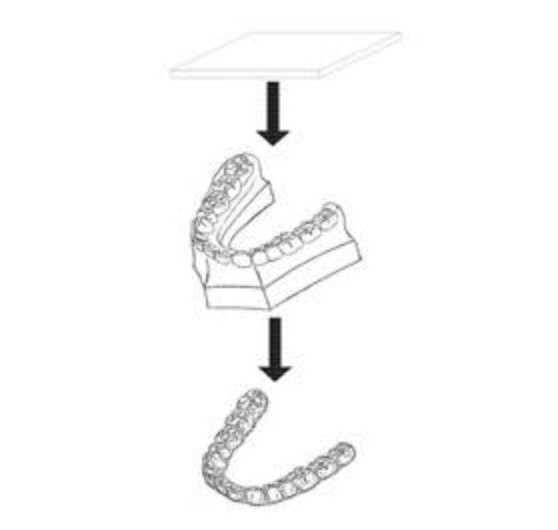
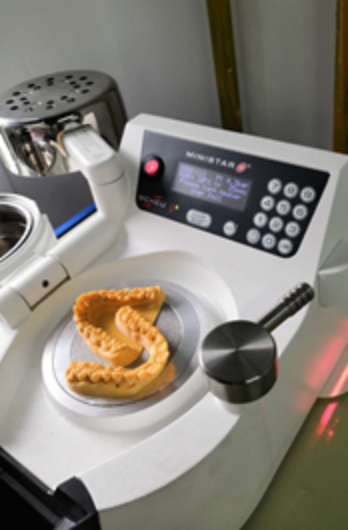
This research is mainly about the research and development of new oral multi-layer invisible correction diaphragms and braces. The goal of orthodontics is to move a patient's teeth into a position that optimizes function and/or aesthetics. The main purpose of this study is to use invisible braces to move the patient's tooth position to achieve balance, stability and beauty of the oral and maxillofacial system. Traditional braces, such as brackets, are made by the treating doctor applying an archwire to the patient's teeth. The archwire exerts a continuous force on the patient and gradually pushes them closer to the doctor's intended position. With treatment Over time, a series of shifting adjustments will eventually move the teeth to the desired position. However, traditional orthodontics use brackets and archwires, which affect the appearance and are prone to leaving food debris in the brackets. Bacteria can easily breed in the oral cavity. Brackets and archwires can irritate mucous membranes and soft tissues, causing discomfort or soft tissue inflammation, and the occurrence of dental caries.
The invention of the invisible correction diaphragm prompted the development of invisible correction technology, which can solve these clinical problems. However, there is currently a problem in the process of invisible correction that the force exerted by the orthodontic diaphragm cannot be sustained and stable, and the patient's teeth cannot be moved to the desired position to obtain satisfactory orthodontic effect. In addition, the hardness of the commercial invisible correction diaphragm is too high. High, poor patient comfort and experience and other shortcomings.
The present invention starts from the fact that the design of the diaphragm (multi-layer sandwich structure design) can have stable deformation recovery force and provide continuous pulling force, overcome this shortcoming, and can improve the comfort during treatment. Yao Lu has applied for a patent for this research and is developing and further testing its physical and chemical properties. Laboratory data support the scientificity and feasibility of the design.
Telephone:+86 755-23256198
Zip code:518118
Address:No. 3002, Lantian Road, Pingshan District, Shenzhen, Guangdong, China.

SZTU WeChat Public Account

SGIM WeChat Public Account

Copyright @SZTU
